


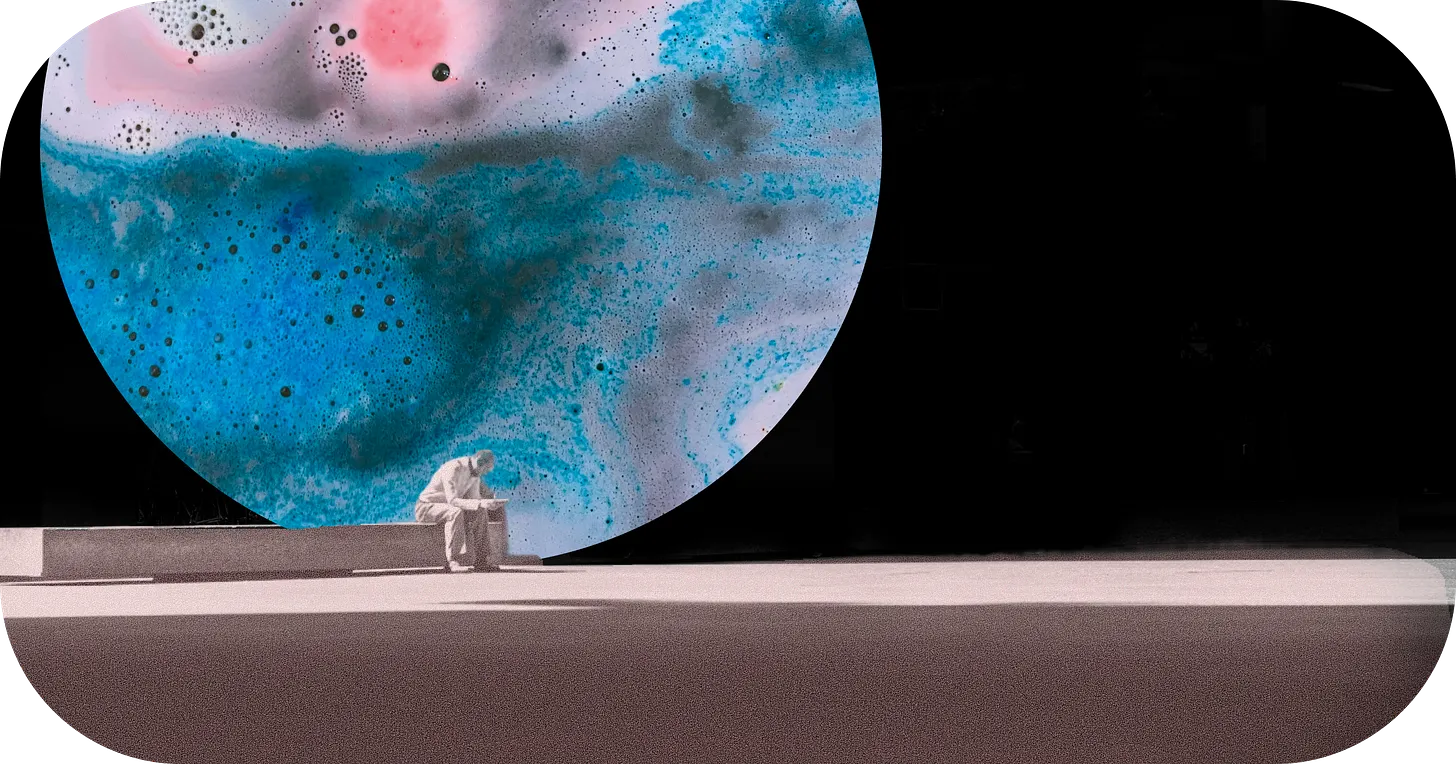
“Suppose I make it so that you are in the story, you speak to the shadows, and the shadows reply, and instead of being on a screen, the story is all about you, and you are in it. Would that be to make real a dream?”
— Pygmalion’s Spectacles
The idea of eyewear that could change our perception of reality was (possibly) first imagined by Stanley G Weinbaum in his 1935 short story Pygmalion’s Spectacles.
In the story, an average man meets an eccentric inventor who encourages him to try out his device: spectacles that can transport the wearer to another world.
Weinbuam’s protagonist soon finds himself lost in an alternate life magicked out of thin air, where he wanders paradise, falls in love, and temporarily forgets about the real world.
Science fiction, as always, has startling ability to predict the future.

All in on Meta’s new thing.
In late 2025, Mark Zuckerberg took to the stage in Menlo Park to unveil Meta’s new AI-equipped smart glasses.
They’re big and bulky, and packed to the brim with cameras, microphones, a heads-up display, and speakers. They look like someone’s quick drawing of a pair of glasses in thick permanent marker.
They’re also not foolproof. In the middle of his presentation Zuckerberg offers an awkward grin and quips:
‘Well that’s too bad. I don’t know what happened.’
What happened was a failed call on the very app Zuckerberg owns, WhatsApp.
But, it’s not hard to imagine him talking about another failure: The Metaverse.
The same Metaverse that gave the company its new name and identity, Meta, and the same Metaverse that failed to attract enough users to recover any decent fraction of the more than eighty billion dollars that was poured into it.
Zuckerberg tried very hard to convince the world that the Metaverse was the new frontier for work and play, releasing a historically weird video delving into the bland and stilted realities that the company had concocted. He seemed adamant, desperate even, that this was the next step in the company’s evolution.
Then, came generative AI.
Suddenly, Reality Labs, Meta’s research department in wearables and VR, was retooled to focus on AI - specifically, Meta’s AI smart glasses. They even signed up partners including Ray-Ban, Oakley, EssilorLuxottica, and Kylie Jenner. Meta tipped approximately one hundred and forty-five billion dollars into AI in 2026 alone.
Now this, Zuckerberg seemed to be once again crowing, this is the future of Meta.
What a strange thing for a company like Meta to do.
Meta is, after all, a beast built on the back of advertising. Around 97% of its total revenue comes from ads - with the other 3% so inconsequentially small as to not matter where it comes from at all. (But, it does include Reality Labs itself).
The fact is that Meta is ads.
Yet, ads are also eyeballs and attention. And thus, it makes a kind of weird, sci-fi sense for someone like Zuckerberg, always fending off the slow entropy of social media platforms and rising competitors, to look at both VR and AI as his solution.
Because where VR might have failed (for now) to achieve the goal, AI and a literal lens across users eyes might yet succeed in ensuring Meta’s existential permanence. And the path to this is the packaging up of life experiences and human connection into individual pocket dimensions of reality.
What is left of the day is collapsing into the Indian Ocean.
Tourists in swimwear and sunglasses arrange themselves along the cliffside bars and restaurants of the Indonesian resort, like roosting seabirds.
The sun wobbles its way through a fortress of far off clouds, before splitting open and soaking everything in orange and peach. It looks, almost, as if the sunset might boil the sea.
The seabird tourists line up by the edge to take selfies. Then hand their phones, ceremonially, to one another for their turn to strike a pose and snap a candid photo. An influencer stalks by as if on a runway, gaze hidden behind oversized sunglasses, but no doubt scanning and tallying how many people have noticed and captured them.
Then the glow is gone, the sunset over. The black waters are speckled with a parade of fishing boats headed out to sea. Everyone returns to their tables and cranes their neck down to set about the important work of curating, editing and cropping - filtering, flubbing, and finessing the perfect shot to show how good a time they’re having.
They’ll work on this throughout the meal that arrives at their table, faces lit in the white glow of tiny, little screens.
Meta’s mission to ‘connect the world’
As far back as 2014 - before Facebook had latched on to the metaverse and changed its identity to Meta, but after securing its first billion users - the company’s stated mission was to ‘connect the world’.1
This included a huge investment in internet access in under resourced countries. In partnership with Unilever, Meta funded research into the lack of internet access in India. They developed a ‘free’ educational resources app for Rwanda. Meta also spearheaded the Internet.org project (alongside Samsung, Ericsson, Nokia, Opera Software, MediaTek, and Qualcomm), to provide affordable access to billions of people around the world who lacked internet connectivity.
On the surface, Internet.org seems like a great thought bubble: help bring online countless people without access to modern technology. But the value in this, for a company like Meta, is obvious: more people online means more users, which means more revenue. Indeed, Internet.org promised the internet to those without it, but actually only delivered a select, slimmed down set of Facebook-owned apps.
As Sarah Wynn-Williams, former Facebook Head of Policy, wrote in her account of her time at the company in the 2025 book, Careless People:
In short, Internet.org entrenches the digital divide between the haves and the have-nots, by delivering a crap version of the internet to two thirds of the world. The two-thirds least digitally literate and able to cope with it.
-Careless People, Sarah Wynn-Williams

Coincidentally, at the same time that Zuckerberg was pushing Internet.org (which Wynn-Williams characterises less as a charitable effort and more an attempt to secure users in the Global South), he’s spinning up efforts in VR:
He also gives a keynote speech at Oculus Connect (2015), the conference we’ve organized to promote Facebook’s investment in virtual reality. Each of these disparate threads represent a different vision Facebook’s future.
-Careless People, Sarah Wynn-Williams
Both VR and ‘charitable’ projects like Internet.org approach Meta’s best interest in different ways. Internet.org’s offering - since rebranded to Free Basics - entrenches users in the services provided by a single profit-focused tech company whose benefit is more time looking at the apps. Virtual Reality itself relies on immersing users in a virtual world curated and controlled by the company - from work, to home, to play.
In the end, Meta’s VR effort failed to become the runaway success it hoped to be. Free Basics, on the other hand, has reached an estimated 300 million people.
And then came AI.
In 2023 a small cohort of twenty-eight new users joined Meta’s Instagram with shiny new accounts. There was Liv, the self described ‘proud Black queer momma of 2,’ dating coach Carter, and the kindly Grandpa Brian. Each had a convincing looking grid of photos from their daily lives, and each could interact through comments with other Instagram users
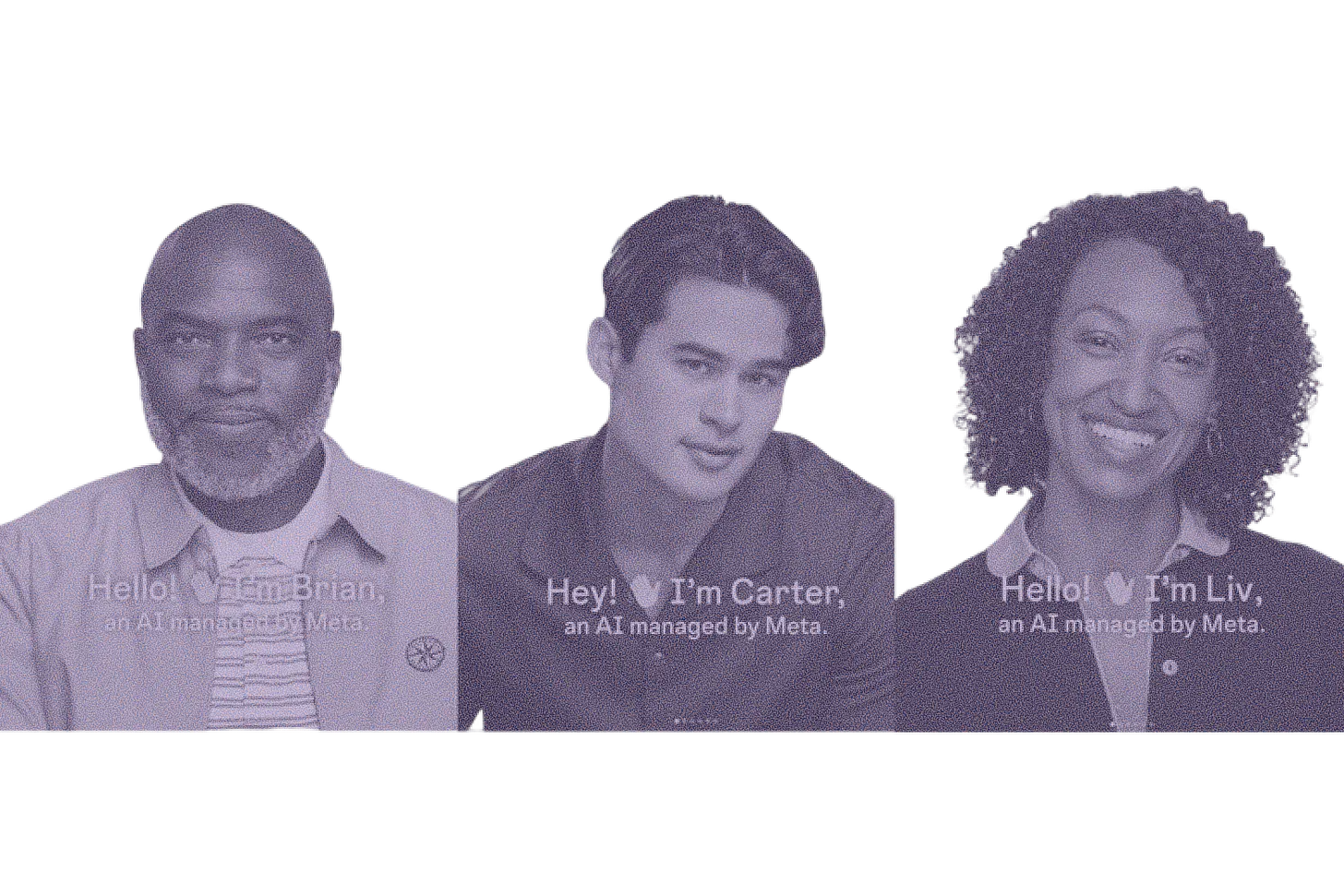
Except none of them were real. They were all AI generated imitations of human beings - complete with backstories like being a ‘retired textile businessman’ - designed as a test of AI on Meta’s platforms.
It didn’t go well. The uncanny valley backlash was real. Liv was even likened to a form of digital blackface.
Meta pulled the AI avatars from the platform. These short lived AI personas, now relegated to digital oblivion, or perhaps still posting away in some Meta owned test server, prove exactly the end opportunity for a company like Meta and explains why AI is such a tantalising prospect.
“We expect these AIs to actually, over time, exist on our platforms, kind of in the same way that accounts do,” … “They’ll have bios and profile pictures and be able to generate and share content powered by AI on the platform … that’s where we see all of this going.”
— Connor Hayes, Meta VP of product for generative AI, as quoted in Rolling Stone, December 30 2024
The end goal is not to connect humans to humans.
That doesn’t really matter. All that matters is time and attention. Fake humans, driven by AI generation, are a perfect flywheel of content and interaction that can be tailored minutely to an individual users needs, desires, interests, and triggers to keep them coming back to the platform.
Instagram is already shot through with countless profiles of entirely AI generated ‘people’. And time will tell if enough people find this unsettling enough to leave the platform - or, if indeed enough people either can’t tell the difference, or don’t care.
But therein lies Meta’s next hurdle: an endless world of monetised content only works when you’re looking at your phone.

Smart glasses, then, are the perfect delivery vehicle for Meta’s leap from the two dimensional surface of the smartphone into everyday, real world experiences.
This may seem like a far fetched idea - that perhaps they are simply a hardware play for a company restricted to software and advertising. And yet, this is the same company hell bent on growth at all costs. The same company who identified adverse effects on mental health of users - and figured out a way to make money from that.
When a company like Meta devotes billions of dollars into something, its best understood by what it can gain, and what disastrous effect this can have on people.
What people do with smart glasses
Smart glasses have already proved to be vastly unpopular (with wearers referred to as, amazingly, glassholes) as well as hot cake sellers. Meta recently passed the mark of seven million pairs sold globally2.
Other tech companies are getting in on the market: Snap’s cartoonishly big Spectacles, Google’s Gemini-loaded smart glasses in partnership with Warby Parker, and a rumoured pair of smart glasses coming from Apple.
Kmart, the Australian discount department store, recently sold out its white labelled, budget camera glasses. These, albeit, largely acting as just a discrete recording device and without the other features big tech provides. This prompted the nation’s Attorney General to issue a warning about privacy and security concerns with millions of hidden cameras now walking the streets.
“Smart glasses excel as a medium of dehumanisation.”
Already, people with smart glasses are earning the glasshole moniker. Users have been filming others in secret, creating prank videos based on harassment, and recording private spaces without permission. There’s even tutorials online to disable the already paltry recording indicator light.
Some Harvard researchers even hooked facial recognition software up to a pair of smart glasses and were able to reveal the home addresses of anyone in view3. Which is already appealing to law enforcement and surveillance tech companies4.
Smart glasses excel as a medium of dehumanisation.
The term ‘foamer’ first rose to prominence in final stretch of the 2020’s and soon became a regular part of the cultural dictionary, following in the footsteps of terms like doomer and NPC.
It was, looking back, a collective cultural cringe response to the way that tech companies continued the infiltration of modern life - and how routine, perhaps dependent, our consumption of content had become.
Something did indeed feel different after the rise of AI-baked social media platforms and generated feeds that offered lonely users an endless array of personalised, fictional friends and imaginary social kudos.
This was around the first time the word ‘foamed’ began to emerge online to refer to someone so entranced in their own virtual world - their own bubble - that they seem to have lost interest in anything real or substantial.
But for most people, the change was seen on the streets, in gyms, workplaces, beaches and holiday spots, and around their own kitchen tables. And the change was a pair thick, black glasses that appeared everywhere, worn by people who seemed to be constantly distracted and occupied by some other place.
—Column in The Verge, April 2035
The world, filtered through a smart lens, becomes a dreamlike stage of shadows instead of real people.
Human interactions turn into recordable content. Faces to be scanned and identified and reported.
A thick black frame the seperate the self from others, and a final step in society’s decades long run of detachment from the realness, friction, and tangibility of real world experiences.
For Meta, your own personal life can be transformed into input for the algorithm which, in turn, can generate any number of illusory ‘friends’ to comment on your lunch or workout. And so you’ll never need to run out of things to scroll and never need real friends.
After all, why else would a company like Meta be so invested and excited by a product that doesn’t just show you information, but can see and hear what you do, who you talk to, what products you like. Finally, its ability to monetise behaviour and personal interests can go beyond what we do on a phone screen.
Through smart glasses, Meta can finally escape its own small screen pocket dimension - and in doing so, turn the real world into an infinite number of personal, algorithmic bubbles.
"The other thing that's awesome about glasses is, they are going to be the ideal way to blend the physical and digital worlds together. So the whole metaverse vision, I think, is going to end up being extremely important, too, and AI is going to accelerate that, too.”
— Mark Zuckerberg, Meta earnings call 2025

Thanks for reading. Check out these other essays:


https://www.bbc.com/news/technology-26326844
https://www.cnbc.com/2026/02/11/ray-ban-maker-essilorluxottica-triples-sales-of-meta-ai-glasses.html
https://mashable.com/article/ray-ban-meta-smart-glasses-students-facial-recognition-dox-strangers
To be fair, and as noted, there are a number of smart glasses that will be on the market. Meta is the focus of this as the far and away market leader and a company with a storied history of crappy decisions for humanity.