



There were nights, when I was little, that never seemed to end.
I’d shut my eyes and try to sleep, but end up staring at the empty ceiling, or at the buzzing digits of my alarm clock. Or out into the mute face of the night that pressed against my bedroom windows.
Maybe something out there, in the darkened scrub, knew what was wrong with me. And if I waited long enough, it might offer up a diagnosis for why my heart sometimes spasmed in my chest. Or why nothing seemed to go the way I wanted. Or why I felt like I never really fit in. But no answer ever came, except the ghostly baby-wail of the bush stone-curlews, calling to say that dawn wasn’t far away and I’d been awake all night.
Hope is the thing with feathers, I’d later learn from Dickinson. But worry, I’ve known since childhood, is a thing with trumpets that calls to you at night.
The bush-stone curlew is a strange creature. It can fly, but mostly scurries about on awkwardly long chopstick-legs, its dishwater feathers camouflaged with the earth. Perpetually tilted like a precarious stack of crockery, the curlew’s yellow serving-dish eyes seem to flick only between the states of curiosity and deep disdain.
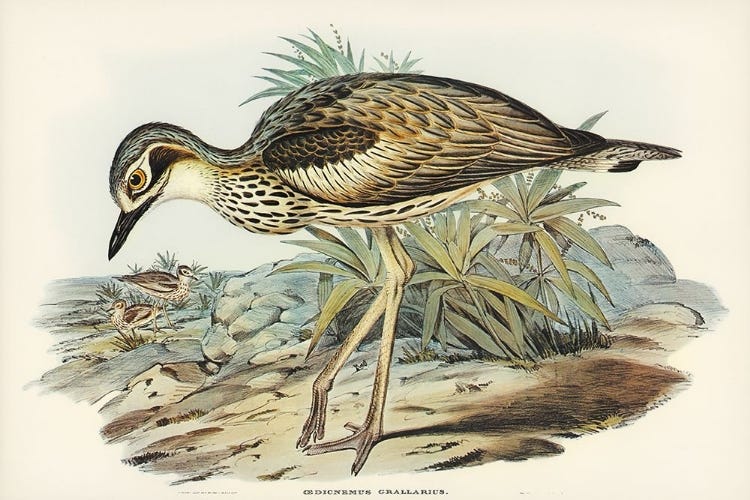
They’ve long been scuttled from the urbanised woodlands around Australian cities to make their nests on the grounds of golf courses, cemeteries, and in piles of leaves and litter that dress the shadowed alleys behind inner-city restaurants. They’re an opportunistic, serendipitous sort of thing that shows up almost everywhere - little strokes of curvy marginalia left all over the pages of a book.
They’re known by a few other names - including the wee-lo. Which sounds exactly as they do in the late thin hours of the night: a long, lilting whistle-scream that sails through the air from somewhere always unseen. For most of my life, it’s been this sound that has met me, bleary-eyed, in the final stages of a failed attempt at sleep, a few hours before morning.
There have been nights in my life that have been objectively terrible. A storm that grounded my broke early-twenty-something self in another city, sleeping on the couch of a co-working office basement. Lost work in an unsaved document for a vital deadline the next day. Or, in the worst of cases, a phone call that carried news of a death like a census update on the population of the beloved.
But there have been more nights lost to an impending sense of calamity that never arrived. It’s a predictable process: as the house lights switch off, something worrisome flickers to life inside my mind with a catalogue of problems to ponder. Problems in the business, relationship problems, or just the run of the mill existential problem of climate change and nuclear war. I know that this is end-of-day exhaustion of my pre-frontal cortex and its waning ability to effectively regulate my emotions, and that the lack of sound and light to distract my mind has encouraged it to find something seemingly purposeful to do with itself. While this is an undeniable fact, it doesn’t help the building pressure of knowing you need to sleep but being increasingly unable to do so.
And then, just as you might start to feel some control over your worries, and that sleep is within your reach: wee-loooo, wee-loooo. And your stomach churns because you know it’s too late.
When my first son was born, we were expecting a very different experience. The first few weeks, one close friend told me, would be like ‘walking on a cloud’. From the moment we walked out of hospital, our little one bundled in our arms like a bony loaf of bread, we were met with congratulations and well wishes. Other people seemed downright excited for the next few weeks that lay ahead of us.
But then we found ourselves consumed by nights that never ended. We would lie there in the blacked out curtained dark, our son in the cot at the foot of our bed, listening to him grizzling and snorting in the farmyard way that new babies do. It was impossible to sleep. When he wasn’t waking to feed, he’d startle us every few minutes with a sleeping goatish bleat.
Worse were the stretches of time when he was still and silent and the thought crosses your mind that maybe now you get to sleep. But then the second thought pops up that maybe he’s quiet because something’s wrong. That he’s stopped breathing. And so you listen, straining your ears, until he bleats again and on and on it goes all night, night after night, week after week.
Eventually, we divide to survive. In shift work, one of us sleeps in the bedroom while the other camps out in the living room with the kid. There’s an understanding that being in the living room means giving up sleep entirely - and one night one of us proudly announces that we got him to sleep for a whole thirty minutes. It’s on one of these living room layovers sitting with my son bundled in my lap, watching an old sitcom re-run, that I’ll hear it.
Wee-loo. Wee-loo.
Strangely, these witching hour calls started to feel a little less taunting. They were even comforting, in a way, as they signalled that the end of the night wasn’t far off and that soon we’d all be in the sunshine. That the worries that had crept into our thoughts, the thing thumping in my chest in the dead of night, would soon scurry itself away in the bright commotion of a new day.
Not long now, not long now.
Maybe that’s what they were trying to say all along.
The house had settled into some sort of manageable sleeping rhythm, when the currawong came to visit. We’d hear it first - a beautiful bubbling aria that rang around across the townhouse complex around five in the morning. In my wisdom, I decided to ruin this by encouraging our little dog to chase him away before he could mark our balcony with droppings. All this did was wake up the entire house with piercing, chicken-hoot cavoodle barking. The currawong got what he came for anyway - left over bits of dog food.
The currawong would appear around spring, likely carrying off his nicked Nature’s Gift kibble to feed some little hatchlings. We’d forget about him in between visits, especially over the cooler, songless months.
My son has been sleeping pretty well for a while, except for some ghastly early morning wake ups. But we’d leave his mum to sleep in and decamp to the living room for play time, warm bottles, and coffee. What was once a purgatorial space had become our private playground. One morning in early spring, as we play-wrestled on the living room floor, my son suddenly froze. He urgently tapped my arm. His eyes and mouth wide, jabbed a chubby little finger over my belly to the balcony.
There sat the currawong. The bird, my boy, and I stared at each other. It seemed as if the currawong was a little annoyed we were up this early. And in a moment, I realised my son was seeing this thing for the very first time.
A sleek, musical bird, hopping between railing and dining chair. A picture book creature come to life, all feathers and wonder.
When my son is two, we’ll move into a forested little pocket of hillside houses. He’ll sit in the bath one night, chattering with me about all sorts of toddler nonsense. And then he’ll stop and point to the ceiling, What that sound?
That, I’ll explain to him, is the sound of a kookaburra. He’ll repeat the word to me, and then every time they fly over our little cottage he will exclaim in surprise. Kookaburra! Even though he’s never actually seen one. I wonder what they might mean to him, while his little boy brain does the hard work of making sense of everything. I hope they mean something like home, or dad.
One day in the future - and probably sooner than I expect - my son will be up all night with worry. He might hear the curlews. But I hope he listens to what they’re trying say. And that he has the means to think of currawongs, and kookaburras, too.
This is the first in a series of essays-in-reply. Send me what's keeping you up — anonymously, if you like — and I’ll write an essay back. Submit here.